Monday, April 30, 2012

Fossil Fish Found Alive: Discovering the Coelacanth.

I read the book Fossil Fish Found Alive: Discovering the Coelacanth by Sally M. Walker, and it was very informative about Coelacanths. It didn't take long to read and it was great.


The book talks about how the earliest modern day Coelacanth to be found was caught in 1938 off the Camoros Islands, which are a French colony off the coast of Africa. This Coelacanth was named Latimeria chalumnae, after the person who discovered it, who had the last name Latimer. 


Latimer had no idea what the fish in her net was, so she took it to several places and asked what it was. They all said that they did not know. The last place she took it to said it looked like a Coelacanth, which at the time was thought to be extinct. The Coelacanth was believed to have gone extinct 65 million years ago, and at the time, the last Coelacanth fossils were 70 million years ago. No Cenozoic fossils of Coelacanths have ever been found, so to date the prehistory of Coelacanths stops in the Cretaceous. 


Prehistoric Coelacanths, from top to bottom: Allenypterus, Hoplophegis, Mawsonia, Axelrodicthys, and Miguashaia
© lifebeforethedinosaurs.com


Somebody named Smith came to see the Coelacanth and proved its identity. Smith wanted to find another Coelacanth. He caught an unusual fish in his net in the Camoros Islands. He thought it was a new species and named it Malania anjouanae. But then he realized his mistake. It was a Coelacanth. The dorsal fins and epicaudal fins were missing from this fish, so he thought it was a new species. The fins were probably just bitten off by another fish when the Coelacanth was young, or another such accident. It was not a different species. 


The modern day Coelacanth Latimeria
© lifebeforethedinosaurs.com


A new species of Coelacanth was described around 1998 and it was named Latimeria menadoensis. It was found in Indonesia, which is in Asia. That's unusual because so far Coelacanths had only been found in Africa and Madagascar, never in Asia. 

Scientists were desperate to find a live Coelacanth in its natural habitat. They started diving down in submersibles to habitats of Coelacanths. On October 29, 2000, they were finally successful and found live Coelacanths in South Africa. At first they found one, but then, on the next dive, they found many. They noticed that when the submersible got close, the Coelacanths did bizarre headstands. It was later found out that these were probably because the Coelacanths use the earth's electrical field to navigate, and in the disturbance of the electrical field they automatically did the headstands because of disorientation. 


It was found out that in the daytime Coelacanths rest in caves and only come out at night. When scientists started tagging Coelacanths, they found that they drifted around in the current, and when prey such as small fish got near, the Coelacanths sucked them in. This is another adaptation that conserves energy. 


Latimeria resting in a cave in the daytime
© lifebeforethedinosaurs.com


The largest Latimeria chalumnae ever found was 6-1/2 feet long. This population of Coelacanths was also the shallowest-living ever found, with depths of 344 feet. They were filmed by divers, but diving at that depth can be dangerous. Coelacanths usually live at about 700 feet down, so normally they would never be filmed by scuba divers. 

Coelacanths are one of the two groups of lobe-finned fish, or sarcopterygians, alive today. The other group are the famous lungfishes, which have the ability to breath air and can live under dried-up lakes for years. Unlike lungfish, Coelacanths, or at least modern day Coelacanths, live in salt water. There were a few prehistoric Coelacanths, like Undina from the Jurassic, that spent their lives in fresh water. The largest Coelacanth ever was Mawsonia gigas, from the Cretaceous from Egypt and Niger. Mawsonia was also found in South America, but this makes sense if you know that Africa and South America were joined together in the Cretaceous (which also explains the distribution of lungfishes in South America and Africa).

I learned that Coelacanths are full of oil, which helps them maintain balance just above the sea floor without having to actually move. The oil also makes the Coelacanth very disgusting to eat, which is why fisherman don't usually fish for Coelacanths as food. The reason why Coelacanths are fished is normally for maintaining specimens. 

Friday, April 20, 2012

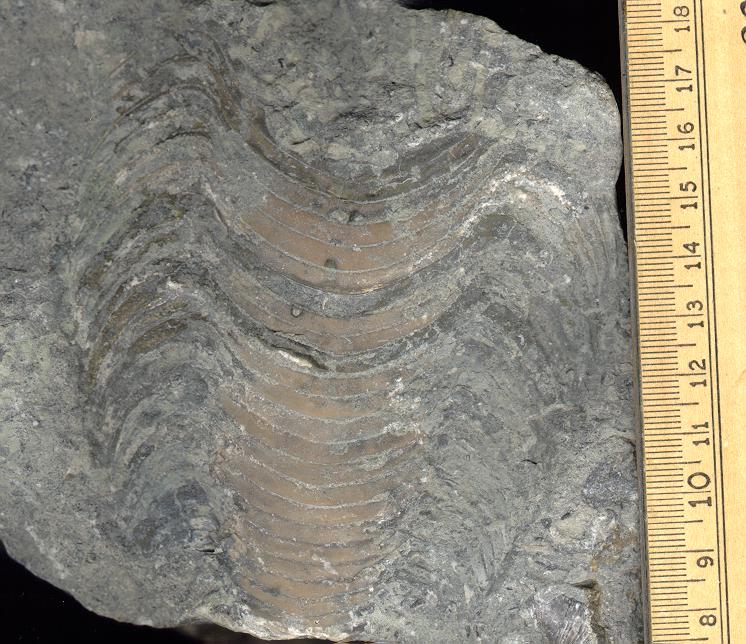
Gonioceras.

Gonioceras was a benthic actinocerid orthocone of the Ordovician. Its distribution included the eastern half of North America, including Canada and the North Pole area next to Greenland. This would not have meant that it was a polar animal, it just means that the continents have shifted a lot, and that the climate has also changed quite a bit. In the Ordovician, the whole world was tropical, even the poles.

Gonioceras had a convex top of the shell and the bottom was flat. This was ideal for living on the sea floor, because that meant Gonioceras would not sink into the muck. This is the same principle as the spines of many trilobite, which helped the trilobites keep themselves from sinking into soft mud. Trace fossils show that tubular-shelled nautiloids did sometimes rest on the bottom, but they did not live their whole life there as Gonioceras did. Tubular-shelled nautiloids such as Cameroceras also probably sometimes dragged across the bottom to catch trilobites and other benthic prey.

Gonioceras chasing a trilobite
© lifebeforethedinosaurs.com


Gonioceras was a unique nautiloid because it was flat. Unlike other nautiloids, it had a triangular form. The name Gonioceras, meaning "angle horn," well suits this animal, because few other nautiloids, except for other actinocerids, were flat and triangular like this.

Gonioceras grew up to about one foot long. I hypothesize that it probably had little or no need for a complex balancing system because it almost always stayed touching the bottom, and it probably never ventured into midwater. For a creature this shape, hatched on the bottom of the ocean, it would take quite a long time for it to get its flat shape into the water. The shell could be compared to a one-foot-long flat rock, and it would have been very hard for such a small animal to lift such a heavy object up into the water. The shell would have been heavy in the first place, and considering the weights Gonioceras would have needed to keep the gas in its shell from slowing making it float up to the surface, it would have been very heavy. So it would have been hard for Gonioceras to lift itself up more than a few inches off the sea floor.

Top and side view of Goniceras
© lifebeforethedinosaurs.com

Gonioceras was actually smaller than its shell, because only a small part of the shell houses the live animal, which would have been a couple of inches long. Its bottom-dwelling habits must have meant that it preyed on bottom-dwelling animals like trilobites or worms. Rays and flounders may have a similar place in the food chain today as Gonioceras did in the Ordovician.

The only living relatives of Gonioceras are of the genera nautilus or allonautilus. Actinocerids like Gonioceras only lived in the Ordovician, but other orthocones lived to the Triassic, and orthocone-like ammonites such as Baculites lived in the Cretaceous.

Gonioceras was probably preyed on by eurypterids and larger nautiloids. Like all cephalopods, they had many tentacles surrounding a beak-like mouth, a syphon propelling them through the water, and a mantle behind their head. Nautiloids and aminoids are the only shelled cephalopods, besides the modern genus argonauta, a shelled octopus. Members of this genus can leave their shells at any time, and only the females have shells. The shells of Gonioceras were probably more delicate than those of other orthocones, because they were flatter and thinner. The whole shell is very rarely preserved in a fossil.

Gonioceras could probably partially bury itself in sand with backward shovel-like motions of its shell being propelled by the syphon,and its tentacles throwing sand on top of its body, similar to living rays and flounders, who do this with their fins. Some living cephalopods sometimes bury themselves by throwing sand on top of their body with their tentacles.

Gonioceras resting on the sea floor
© lifebeforethedinosaurs.com


Although nautiloids like Gonioceras and the modern nautilus do not have suckers on their tentacles, they have a very strong grip. Modern nautiloids can hardly ever be pulled off of their prey without ripping off their tentacles because the grip is so strong. Nautiloids also have more tentacles than other cephalopods.

Because of its flat shape, Gonioceras probably would have been very hydrodynamic on the sea floor, jetting itself quickly just above the bottom. Since the ventral side of its shell was flat, it would have been much easier for Gonioceras to rest on a flat surface such as sand or mud than on rocks, which meant it probably lived closer to sandy shores. Orthocones could not have lived in the deep sea because their shells would have cracked due to the pressure. Coiled nautiloids could have easily gone into deep water because their tightly-packed shells would have offered more protection.


References:

http://www.threedee.com/jmosn/fossils/gonio/index.html

http://en.wikipedia.org/wiki/Gonioceras

http://paleodb.org/cgi-bin/bridge.pl?a=basicTaxonInfo&taxon_no=12674

http://www.flickr.com/photos/ypsidixit/2228092890/

Thursday, April 5, 2012

Lepidodendron.

Lepidodendron was a giant lycopod tree that flourished in Carboniferous wetlands. It was up to 130 feet tall. 


For half of its life Lepidodendron lived as a telephone pole-like plant sticking out of the forest floor. Then it began branching. Finally, the branching growth stopped and spore cones formed at the end of the branches. Growth stopped. The tree was putting all its energy into making and releasing spores. 


In some species of Lepidodendron the tree died after it was finished releasing its spores, probably because they spent all their energy on doing just that, shedding and making spores. This is like salmon who die right after laying eggs because they use up all their energy swimming up rivers and jumping up waterfalls, and spend the last bit of energy laying eggs and transferring sperm to the female. 


© lifebeforethedinosaurs.com


Lepidodendron and other lycopod trees had the shallowest roots I've ever heard of. The roots barely went a couple feet into the ground for an enormous 100 foot tree. One of the reasons 
Lepidodendron didn't fall down was probably that, despite its enormous size, the trunk was probably pretty light. Inside the thick bark there was a cotton-like substance, which was the vascular system. Another reason Lepidodendron didn't fall down is probably that the roots were fat and also surprisingly long. But they barely went into the ground and were nearly unbranched. The bark of Lepidodendron was a couple of inches thick, which held the tree in an upright position. 


© lifebeforethedinosaurs.com


Lepidodendron had bark covered in scaly leaf scars. In the "telephone pole" stage, the leaves were gradually moving up the trunk. As the tree got larger, and older leaves fell off. Finally this process stopped as Lepidodendron started to grow its first branches. The first branches it grew were forked, and then off of those forks it grew branches that looked somewhat like those of conifers. 


Some people used to think that the bark was the remains of a giant snake or lizard, which turned out to be totally wrong. 


© lifebeforethedinosaurs.com


References:


Prehistoric Life: The Definitive Visual History of Life on Earth, pg. 145


http://steurh.home.xs4all.nl/eng/lepido.html

http://en.wikipedia.org/wiki/Lepidodendron

Friday, March 23, 2012

Cameroceras (Part 2).

I've written about Cameroceras before, but there is more about this relative of the modern nautilus that I would like to explain. 


Cameroceras is a species of Ordovician nautiloid that had a straight shell right behind its head. It belongs to a group of nautiloids called orthocones, along with Orthoceras, Endoceras, and Gonioceras. 


© lifebeforethedinosaurs.com


Although the widely accepted size estimate of Cameroceras's length is 20 feet, there is some debate. Paleontologists often find partial shells of Cameroceras, very rarely the whole thing. When they do find a complete specimen of the shell, it is usually of a small individual. Unless we have the living chamber or the tip of the shell in the specimen, we cannot accurately determine the length of the animal. Based on partial specimens of large individuals, we can only know that it could have grown very big, but not the exact length. In the future we may find a way to determine which part of the shell the fossil belonged to. 


In the image below, I drew Cameroceras hunting near the seabed. This individual has successfully caught the eurypterid Megalograptus. Another Megalograptus is swimming away, and Isotelus is crawling on the sea floor directly below the Megalograptus. On the left side, near the head of Cameroceras, there are two rugose corals and one crinoid. 


© lifebeforethedinosaurs.com


Like the modern nautilus, Cameroceras probably had an extremely strong grip with its tentacles. Once something was caught, it would be very hard for the prey to escape. The tentacles were probably stronger than those of the nautilus, because Cameroceras was much bigger (the modern nautilus only has a shell diameter of 8 inches). 


Cameroceras had an amazing way of keeping its head from facing towards the bottom of the ocean and the tip of its shell from facing towards the surface. Cameroceras had a long siphuncle, a kind of tube, running down from its siphon. The siphuncle had traffic cone-shaped blocks of calcium in it, which counter-weighted the body and kept it horizontal. Like all nautiloids, it had upward-facing rings called septa. They were filled with gas and kept Cameroceras afloat. It was a very efficient strategy of locomotion. 


© lifebeforethedinosaurs.com


The siphon, which was connected to the siphuncle, sucked in water and then shot it out again to propel Cameroceras in the opposite direction of whatever way the extremely flexible siphon was pointing. Modern cephalopods can swim backwards and forwards and also steer very well, because of the flexibility of their siphon. Cameroceras probably had a very flexible siphon too, and this extreme maneuverability would have made it an efficient hunter. 


References: 


A Sea Without Fish by David L. Meyer and Richard Arnold Davis, pg. 132-134.


http://en.wikipedia.org/wiki/Nautilus

Thanks to Paul Mayer at the Field Museum for discussing how paleontologists find out the size of orthocones when they don't have the complete shell. 


Tuesday, March 6, 2012

New research on Pikaia from Simon Conway Morris and Jean-Bernard Caron.


In Pikaia gracilens Walcott, a stem-group chordate from the Middle Cambrian of British Columbia, published online March 4, 2012, Simon Conway Morris and Jean-Bernard Caron confirmed that Pikaia was a chordate after all. They looked at the anatomy of 114 specimens of Pikaia (I thought there were only 16 known Pikaias!)and found myomeres, v-shaped blocks of skeletal tissue that are only found in chordates. The scientists also found evidence of a vascular system, and found that at least part of the alimentary canal was preserved in almost every specimen. 


Externally, Pikaia was mostly just a flattened, tie-shaped body tapering from a tiny head. It had tentacles on its head, two antennae, and a thin dorsal fin. 


What was first thought to be the notochord in Pikaia is now interpreted as a "dorsal organ," which was possibly hollow. This doesn't mean there's no notochord. Under this dorsal organ there is a thread of tissue that is now interpreted as the notochord and nerve chord. 


I've only read the abstract, but when I read the actual article I'll learn more information. 

Friday, March 2, 2012

Chicago After The Field Museum (Part 4 of 4): Shedd Aquarium.

I went to Shedd Aquarium and it was so cool. They had an exhibit on jellyfish, which I was excited about. They had really weird jellyfish. 

They had a really big tank full of moon jellies and it was packed. There were jellyfish in a huge swarm and each had a bell that was about one foot across. I could even see the orange food that they had eaten because they were so transparent. It was all up inside their stomach, which is in the center of the jellyfish.


The moon jellies were so cool that we took a video of them:


Jellyfish have been around since the Cambrian Period, and I have a couple of fossilized jellyfish from the Carboniferous Mazon Creek.


These are sea nettle jellyfish. Their pulses looked very strong, and that probably helps them drawn water into their bell with plankton, and then push out all the plankton onto their tentacles, where it is then stung and killed, and then fed to the mouth.


These are upside-down jellyfish, a very bizarre kind of jellyfish that spends almost its whole life stuck upside-down to the bottom of the ocean (hence the name upside-down jellyfish). Although this is for a reason. They have algae living inside their bodies which gives them food. In turn, the jellyfish stick upside-down to the bottom and face the light, which helps the algae grow. They have a symbiotic relationship with the algae.


These are called hairy jellyfish, which is obvious when you look at their tentacles, which are very thin and hair-like. They also were very slow, and there was a lot of time between each pulse. They look a lot like some deep sea jellyfish, and they also look like box jellyfish a little bit. 


This is a video of Pacific sea nettle jellyfish, a larger species of sea nettle than the ones in the photograph  I previously mentioned. It's a really cool video. The jellyfish seem even stronger than the other sea nettles, and they are certainly formidable predators of copepods and other plankton. 


This photograph is of two arapaimas, a type of fish from the Amazon River that grows to ten feet long, and is also a living fossil that has its origins in the Cretaceous. The related arowana is also a living fossil. They had those at Shedd Aquarium, but I didn't get a picture. They were about one or two feet long.


This is a picture of me posing next to a freshwater stingray from the Amazon River. It is stuck to the glass, and its mouth and gills are clearly visible. I thought the freshwater stingrays were really amazing.


This was a huge life-sized model of an arapaima, which shows just how big they can get. The scales were huge.


This is an image of a huge school of cardinal tetras, a fish from the Amazon River which is commonly found at pet stores, probably because of how beautiful the shimmering swarms of them can be. I could see them from a long way away. They were so bright. It's almost like they were glowing.


This image shows a moray eel, a beautiful marine eel that grows to ten feet long.


We also saw some electric eels, a type of knifefish that can grow to eight feet long, which makes it the largest knifefish species. They are also deadly because they can shock up to 650 volts.


They had a giant spider crab, the biggest species of crab in the world. In the wild they are often found in the deep sea where they have an opportunistic lifestyle, picking up and eating any scrap of edible debris they can find.


The next day it was time to leave Chicago, and I really didn't want to go. It was so sad to leave.

We went to the airport and the Kronosaurus had to go through the X-ray two times for some reason.


I couldn't stop reading my new book.


Art had a ton of new experiences and a fantastic time in Chicago. A million thanks to: Paul Mayer, Jane Hanna, University of Chicago Secular Student Alliance, Stephen & Kayla & Greta, Casey, Mike, Dave Monroe, PZ Myers, and the 72 incredible people who pitched in to help fund our trip to the Field Museum. 

Wednesday, February 29, 2012

The Field Museum (Part 3 of 4): Birthday and the Burgess Shale Screen.

When we woke up in the museum after Dozin' with the Dinos, I quickly looked around again in Evolving Planet. Then we went back to the hotel to celebrate my birthday.


Stephen brought me a birthday cake with a spotted lagoon jellyfish and a sea nettle jellyfish on it. I got some presents, like this and this from my parents, this from Stephen, and this from Dave. Then we went back to the Field Museum. 


There's a Burgess Shale video with three screens in Evolving Planet that makes it seem like the creatures are in a huge aquarium. On our first night at the museum, the screen wasn't on and I was very disappointed. We thought it might be broken because somebody told us that. But when we went back the next day it was on! 


Here is Pikaia swimming past. It happens to be about to swim over some Ottoia burrows. 


For some reason we didn't take a video of the screen, but it was really cool. Here is Opabinia (in the lower left corner) and Wiwaxia (in the middle). 


I thought the Burgess Shale screen was really cool, and my two favorite parts where when the Anomalocaris chased all the trilobites and got one, and when the Opabinia tried to catch an Ottoia. It finally caught one, but lost its grip and the worm quickly went back into its burrow. 


Here's a picture of an Ottoia coming out of its burrow in the middle of the screen. It's blurred because it was moving so fast. It went back in as fast as it came out.


This picture is really cool, and not to mention the quote from Charles Darwin is amazing. 


Stephen took us to SushiSamba and it was great. I had sushi for the first time. I got octopus and freshwater eel and I loved it. I also had tuna, striped bass, and crab. I wanted to get sea urchin but they didn't have it that day. 

Sushi platter.

Freshwater eel. 


We went to see "The Bean," which is really called Cloud Gate. It's a giant stainless steel sculpture that's about as old as me. It was designed by Anish Kapoor and I thought it was really cool. The night we were there there was a light show, and I was jumping on the lights. The lights were reflecting off The Bean and The Bean was reflecting the lights of the city and all the people. You could see Chicago just by looking at The Bean. 


Here I'm underneath The Bean and Stephen is holding me up so I can see my reflection at the top of The Bean. 


Behind me and Kayla is a big sculpture made of glass blocks with lights inside. On the sculpture there was a face and it was actually moving. In the summertime, Stephen said the face squirts water out of its mouth, and people can play in it. That's kind of cool, and I think a sculpture with a moving face is kind of weirdly hilarious. 


Thanks so much to Stephen, Kayla, and Dave for traveling to meet us in Chicago. I had an awesome birthday. I like Chicago better than where I live!


Next up:

Part 4 of 4: Bonus day at Shedd Aquarium!

A million thanks to: Paul Mayer, Jane Hanna, University of Chicago Secular Student Alliance, Stephen & Kayla & Greta, Casey, Mike, Dave Monroe, PZ Myers, and the 72 incredible people who pitched in to help fund our trip to the Field Museum.